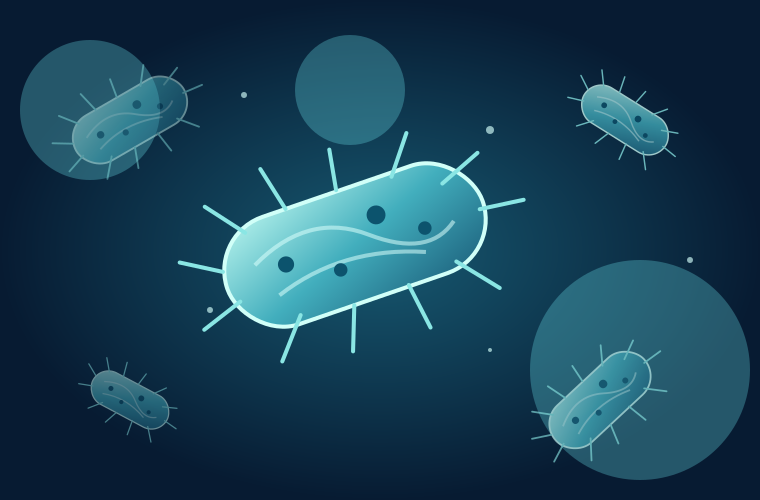
Imagine that at eight in the morning, a single Escherichia coli bacterium enters an ideal nutrient broth. If nothing stopped it, by seven in the evening it could outnumber the people on Earth. Mathematically, this is possible; biologically, it almost never happens. That gap between calculation and reality is the heart of this story.
While human populations take years to change substantially, some bacteria can double in minutes. This is exponential growth: one cell divides into two, those two into four, and four into eight. Numbers rise faster and faster as long as conditions allow division to continue.
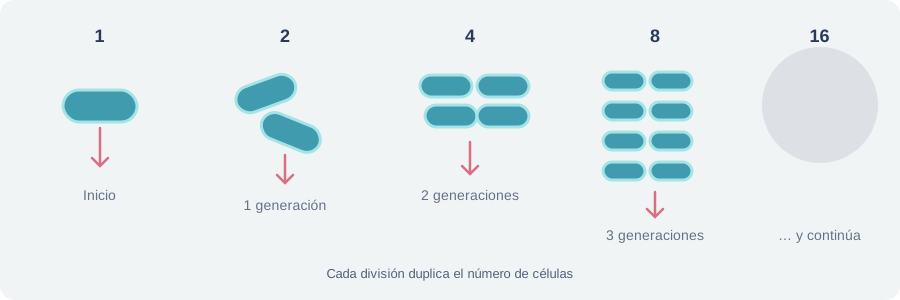
How long would a bacterium take to match humanity?
Let us use an approximate human population of 8.3 billion. The mathematical growth model is:
N(t) = number of bacteria at time t
N₀ = starting amount (1)
T = doubling time
It takes 33 doublings to exceed 8.3 billion, because 2³³ = 8,589,934,592. A bacterium doubling every 20 minutes would reach that theoretical figure in about 11 hours, provided every division occurred uninterrupted, with no nutrient shortage or waste accumulation.
Ten bacteria: growth rates and human diseases
These are indicative approximations under favorable laboratory conditions. They vary with strain, temperature, nutrients, oxygen, and culture medium. In natural environments, doubling times are often considerably longer.
| Bacterium | Doubling time | Theoretical time to exceed 8.3 billion | Diseases it may cause |
|---|---|---|---|
| Escherichia coli | 20 min | ~11 h | Urinary tract infections, gastroenteritis and, in certain strains, hemorrhagic colitis |
| Staphylococcus aureus | 27–30 min | 14 h 51 min – 16 h 30 min | Skin infections, abscesses, pneumonia and invasive infections |
| Salmonella enterica | 30–50 min | 16 h 30 min – 27 h 30 min | Salmonellosis and, in some serotypes, typhoid fever |
| Vibrio cholerae | ~40 min | ~22 h | Cholera |
| Pseudomonas aeruginosa | 30–60 min | 16 h 30 min – 33 h | Pneumonia and wound, burn, or bloodstream infections, especially in vulnerable people |
| Bacillus subtilis | 20–30 min | 11 – 16 h 30 min | Usually harmless; infections are uncommon |
| Streptococcus pyogenes | 30–60 min | 16 h 30 min – 33 h | Strep throat, scarlet fever and invasive infections |
| Listeria monocytogenes | 40–60 min | 22 – 33 h | Listeriosis; may cause sepsis or meningitis |
| Neisseria meningitidis | 30–40 min | 16 h 30 min – 22 h | Meningococcal meningitis and meningococcemia |
| Mycobacterium tuberculosis | 18–24 h | 24.75 – 33 days | Tuberculosis |
Important: not all species are equally dangerous. Bacillus subtilis is usually harmless, while certain E. coli strains can cause severe illness. The table lists diseases associated with each species; it does not mean every bacterium in that species causes them.
How many bacteria would there be after seven days?
Suppose each bacterium could keep dividing for seven full days without running out of nutrients, accumulating waste, or dying. These figures are mathematical extrapolations of the exponential model, expressed as orders of magnitude because they are extraordinarily large.
| Bacterium | Assumed doubling time | Theoretical number after 7 days |
|---|---|---|
| Escherichia coli | 20 min | ≈ 5 × 10151 |
| Staphylococcus aureus | 27–30 min | ≈ 10101 – 10112 |
| Salmonella enterica | 30–50 min | ≈ 1061 – 10101 |
| Vibrio cholerae | 40 min | ≈ 1076 |
| Pseudomonas aeruginosa | 30–60 min | ≈ 1051 – 10101 |
| Bacillus subtilis | 20–30 min | ≈ 10101 – 10152 |
| Streptococcus pyogenes | 30–60 min | ≈ 1051 – 10101 |
| Listeria monocytogenes | 40–60 min | ≈ 1051 – 1076 |
| Neisseria meningitidis | 30–40 min | ≈ 1076 – 10101 |
| Mycobacterium tuberculosis | 18–24 h | ≈ 128 – 645 |
Why do such extraordinary numbers appear?
Exponential growth multiplies the existing amount in every generation instead of adding a fixed quantity. Like the story of rice grains on a chessboard, repeated doubling leads to numbers that are hard to imagine.
Fast growth does not necessarily mean greater harm
The severity of an infection depends on a microorganism’s ability to enter the body, evade defenses, produce toxins, invade tissues, and resist treatment. M. tuberculosis grows much more slowly than E. coli and can still cause serious disease.
Seven days: another timescale
A week can represent hundreds of generations for some bacteria under ideal conditions. In nature, resource availability and other factors limit growth.
Further reading
- Gibson B, Wilson DJ, Feil E, Eyre-Walker A. “The distribution of bacterial doubling times in the wild.” Proceedings of the Royal Society B. 2018;285(1880):20180789. DOI y artículo
- Levinson W. Review of Medical Microbiology and Immunology. McGraw Hill. Capítulos sobre crecimiento bacteriano y microbiología médica. AccessMedicine
- American Academy of Microbiology. Environmental Microorganisms as Human Pathogens. American Society for Microbiology
- Centers for Disease Control and Prevention (CDC). Información sobre meningitis bacteriana y patógenos asociados. CDC