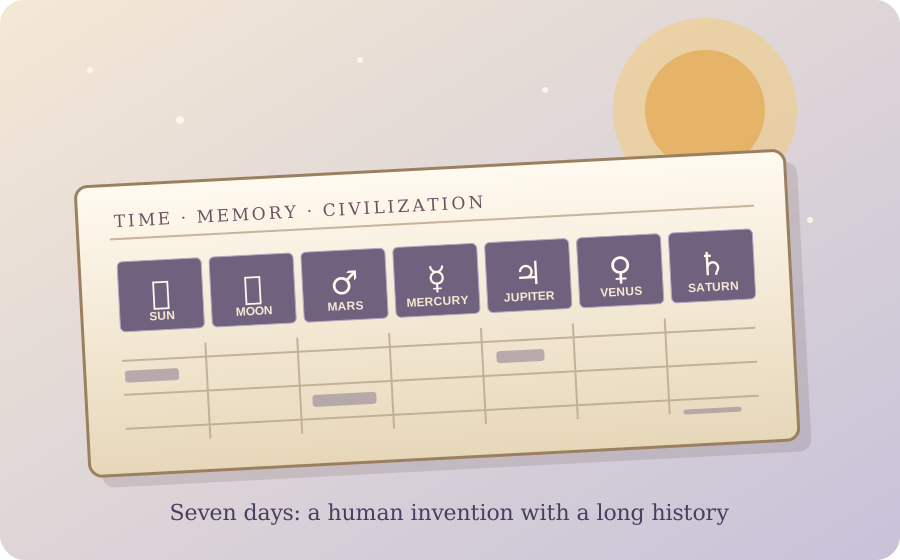
We organize life into seven-day weeks as if the arrangement were natural, almost biological. But nothing in the sky or on Earth requires it. The year follows the Sun; the month approximates the lunar cycle. The week, by contrast, is a human convention that became one of the most enduring structures of everyday life.
Does the Moon explain the seven days?
The lunar explanation is tempting. The Moon’s phase cycle lasts about 29.5 days, and its four principal phases occur at intervals close to a week. Ancient societies watched the sky to measure time, and seven acquired cultural and religious significance. Yet this resemblance does not prove that the modern week simply arose by dividing a lunar month into four parts.
Historical evidence does not support the simple claim that Mesopotamia or Egypt used an uninterrupted seven-day week identical to ours from the earliest times. Different systems organized days and months in different ways. The week, independent of astronomical cycles, emerged through a more complex cultural history.

Two traditions converged
The seven-day week that spread through the Roman world brought together two distinct traditions. The first was the biblical week: in Genesis, creation unfolds over six days, and the seventh is associated with rest. The Jewish Sabbath sustained a weekly religious practice across the centuries.
The second was the planetary week, which linked each day to one of the seven celestial bodies traditionally visible to the naked eye: the Sun, the Moon, and the five planets known in antiquity. This astrological sequence is documented in the Roman West in the second half of the first century BCE and spread gradually. Research by Ilaria Bultrighini and the University College London project examines how these traditions coexisted and spread.
In Spanish, Monday through Friday preserve the planetary associations clearly: Moon, Mars, Mercury, Jupiter, and Venus. Sábado derives from the Hebrew shabbat; domingo comes from the Christian Latin dies dominicus, “the Lord’s day.” Other languages preserve different traces of the same history.
Constantine did not invent the week
Rome had used an eight-day market cycle known as the nundinum. Over time, the seven-day week gained ground. In 321 CE, Emperor Constantine ordered judges, urban residents, and workshops to rest on dies Solis, the “day of the Sun,” with an exception for agricultural work.
The edict did not create the seven-day week; it gave legal backing to a cycle already in circulation. The measure helped establish Sunday as an official day of rest in a society where Roman, Jewish, and Christian practices coexisted. Esteban Moreno Resano’s study examines the law in its political and legislative context, so it is best not to reduce it to a purely religious decision.
Constantine did not invent the weekly rhythm: he turned an established custom into imperial policy.
The French Revolution tried ten-day cycles
The seven-day week has not been the only imaginable option. During the French Revolution, the Republican calendar replaced the week with a ten-day décade: each month had thirty days grouped into three décades, and rest came every tenth day. The system reflected the ambition to decimalize timekeeping and remove calendar references associated with monarchy and Christianity.
The reform met resistance and proved difficult to fit into social and religious life. Napoleon abolished the Republican calendar by decree on 9 September 1805; the Gregorian calendar returned on 1 January 1806. The French National Assembly documents both the reform’s aims and the difficulties of putting it into practice.
Rest every week
Rest every tenth day
The Soviet Union also changed the rhythm
Between 1929 and 1931, the Soviet Union experimented with a continuous five-day work cycle known as the nepreryvka. Workers were divided into groups with staggered days off so factories could keep operating. In 1931, a six-day work cycle was introduced, with a shared rest day every six days.
The system made it harder for families, friends, and communities to share their free time. A Soviet decree dated 26 June 1940 ordered a return to the seven-day week, with Sunday as the day of rest. Historical studies of the Soviet calendar describe the reform as an attempt to reorganize production that ran up against society’s need for a shared rhythm.
Why did the seven-day week survive?
Attempts to replace it show that a unit of time is more than a mathematical tool. It also coordinates work shifts, schools, markets, celebrations, family gatherings, and religious practices. Changing the number of days changes how people relate to one another through shared calendars.
The seven-day week does not exactly match the lunar cycle or divide the solar year evenly. Its persistence is better explained by historical continuity, custom, and social coordination than by natural necessity. Once different societies adopted the same rhythm, abandoning it carried a considerable practical and cultural cost.
Seven days were not inevitable. Over time, they became the shared rhythm that proved hardest to replace.
The next time you look at a calendar and feel the weight of Monday or the relief of Friday, remember that you are inheriting a convention built over centuries. It is not a law of the stars: it is a story of religion, astrology, political power, and shared life.
References and verifiable further reading
- University College London, Hebrew and Jewish Studies. The seven-day week in the Roman Empire and the Near East. Proyecto académico sobre la difusión y estandarización de la semana. Consultar investigación de UCL
- Bultrighini, I. (2018). “Thursday (dies Iovis) in the Later Roman Empire.” Papers of the British School at Rome, 86, 61–84. DOI: 10.1017/S0068246217000356. Artículo y DOI
- Moreno Resano, E. (2009). “La ley constantiniana del «Dies Solis» en su contexto político y legislativo.” Studia Historica. Historia Antigua, 27, 187–206. Ficha y texto de la Universidad de Salamanca
- Assemblée nationale (France). Convention nationale et calendrier républicain. Documentación institucional sobre la implantación y abolición del calendario republicano. Fuente institucional
- Yushmanova, M. I. (2019). “Continuous Work Week: Outcomes of the Deformation of the Social Time Rhythm.” Etnograficheskoe Obozrenie, 3, 8–26. DOI: 10.31857/S086954150005297-6. Para el restablecimiento legal de la semana de siete días, véase también el decreto soviético del 26 de junio de 1940, reproducido por el proyecto Seventeen Moments in Soviet History de la University of Illinois. Estudio académico · Documento histórico
Editorial note: institutional pages and academic publications with bibliographic records, DOIs, or primary documents were prioritized. This historical overview summarizes specialist research and does not present the lunar-phase explanation as a proven origin.