
Before speaking a word, taking a step, or consciously remembering a face, we have all overcome challenges we will never remember. In just seven days, a newborn begins adapting to a world of light, sound, scent, and sensation. The body starts functioning differently outside the womb, a warm and protected environment. The baby cannot tell us what it feels, but every movement and small response offers a glimpse of this extraordinary adventure.
Day 1. The first breath and first feed
Birth is a revolution—and a tremendous effort.
Labor and birth represent a major physiological challenge for a baby. Hormonal changes, together with other mechanisms, prepare the body for life outside the womb. After birth, the lungs begin clearing the fluid they contained, breathing through the lungs is established, and circulation is reorganized. The body also begins regulating its own temperature.
Temperature changes, sounds arrive differently, and light reaches the eyes. Vision is blurry, but a newborn can distinguish contrasts and shapes at around 20–30 centimeters (8–12 inches), approximately the distance between the baby’s face and the person holding them for feeding.
From the first hours, a baby may search for the breast, open the mouth, turn the head, and bring hands to the mouth. If health and circumstances allow, breastfeeding is recommended within the first hour. Colostrum provides nutrients and protective components. Skin-to-skin contact helps regulate temperature, supports physiological stability, and encourages feeding.
The baby also sleeps in short periods interrupted by wakefulness. We cannot know whether a newborn experiences fear as adults understand it. We do know that warmth, food, and contact help the baby adapt to new conditions.
The first major achievement: passing through birth, beginning to breathe, and feeding outside the womb while the body adapts to a very different environment.
Day 2. Hunger becomes communication
The baby becomes hungry again and again.
Many breastfed newborns feed eight to twelve times in 24 hours, although they may want to feed more often, sometimes in closely spaced clusters. From the first hours, before crying, a baby may search for the breast, move the mouth, or bring hands to the mouth. Crying is often a late sign of hunger.
Sucking, swallowing, and breathing require coordination that is still being refined. Sometimes a baby needs help achieving an effective latch. These skills do not suddenly appear on day two: they begin at birth and continue to develop.
The baby’s language has no words, yet it is remarkably expressive. The family begins to discover that each movement may signal a need.
The challenge: communicating needs and feeding frequently to receive the energy and nutrients required.
Day 3. A world of voices and scents
A baby does not arrive knowing absolutely nothing.
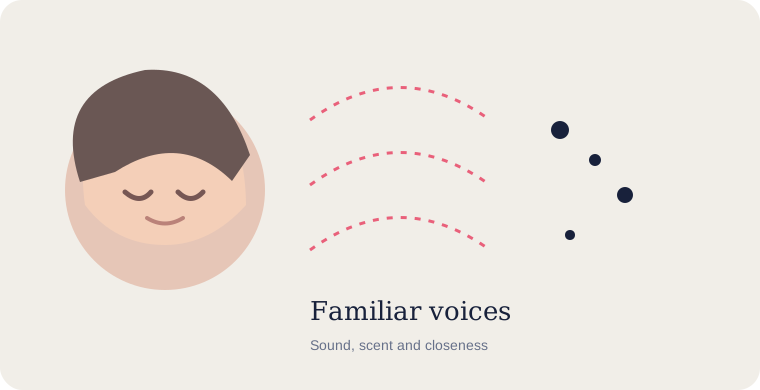
During pregnancy, babies already hear sounds and may show a preference for the maternal voice. They can also respond to familiar scents. These sensory abilities draw on experiences that began before birth.
The eyes continue to explore. A newborn can perceive shapes and some nearby facial features, although vision is not sharp and faces are not yet recognized consistently by sight alone. Visual perception and recognition of people develop gradually over the following months.
Meanwhile, the body continues to adapt. Jaundice, a yellowing of the skin associated with bilirubin buildup, may appear during the first days and often becomes more noticeable between days two and five. Although common, it needs monitoring. Jaundice appearing in the first 24 hours requires immediate medical assessment.
The discovery: some voices, scents, and sensations may feel familiar amid so many changes.
Day 4. Tiredness and comfort
Newborns often sleep around 14–17 hours a day, although there is considerable variation.
They do not sleep continuously: they wake repeatedly to feed and have not yet developed a clear day–night rhythm. When tired, a baby may yawn, look away, move less, or become irritable. Hunger or discomfort may lead to crying or body tension.
When calm, a baby may relax the hands, breathe regularly, and suck peacefully. These cues may suggest comfort or satisfaction, although they cannot tell us exactly what the baby feels.
These behaviors can be seen from the first days; day four does not mark the beginning of a new ability. What changes is the opportunity to observe them and learn to interpret them.
A shared step forward: learning to recognize the baby’s needs and offer comfort.
Day 5. Early signs of familiarity
At a distance of around 20–30 centimeters (8–12 inches), a newborn may perceive the general shapes and features of a face.
The baby may briefly look at the person holding them, although visual attention remains limited. This ability is present from birth and improves gradually. A mother’s voice and scent may already be familiar. Visual recognition of people develops over the first months.
The body continues adapting to feeding. Some initial weight loss is normal; many babies begin regaining weight over the following days and usually return to birth weight by around 10–14 days. Individual progress should be assessed through pediatric follow-up.
A small triumph: finding familiarity in a world the baby is still learning to interpret.
Day 6. The first threads of bonding
A gentle voice, being held, or skin-to-skin contact can help a newborn settle.
These responses can be observed from birth and recur throughout the first days. We do not know whether a baby understands love as an idea, but sensitive, repeated care is essential. Each time someone feeds, comforts, or responds to crying, the baby has experiences that contribute to building a bond with caregivers.
This bond does not begin exclusively on day six. It starts forming through early contact and continues developing as caregiving experiences are repeated.
The family learns too. Caring does not mean having every answer; it means observing, responding, and trying again.
The first major bond: a relationship that begins to grow through closeness, attention, and everyday care.
Day 7. A week that changes everything
Just seven days have passed.
The baby has begun breathing outside the womb, feeds repeatedly, sleeps in short intervals, and responds to voices, scents, touch, and visual stimuli. These processes begin at different times, but unfold simultaneously during the first week and continue beyond it.
The baby still needs help with almost everything. They do not understand the world as an adult does, but the brain is already processing experiences that contribute to development.
No one consciously remembers that first week. Yet we have all been the protagonists of a similar story. Before learning to speak, we already responded to voices. Before consciously recognizing a face, we perceived its shapes. And before understanding the meaning of affection, we already needed other people’s care.
The great achievement: beginning the journey of a human life. An adventure that started with a breath, continued with a first feed, and went on through thousands of small adaptations. Seven days in which a tiny human began discovering the world while the world learned to care for them.
Scientific sources
- World Health Organization — Newborn health
Guidance on essential newborn care, skin-to-skin contact, and early breastfeeding.
- CDC — Newborn breastfeeding basics
Information on feeding frequency and the first weeks.
- HealthyChildren.org — Jaundice in newborns
Pediatric information about jaundice and when to seek care.
- Hillman NH, Kallapur SG, Jobe AH (2012) — Physiology of transition from intrauterine to extrauterine life
Scientific review of physiological transition at birth.
Difficulty breathing, inability to feed, unusual sleepiness, or jaundice in the first 24 hours requires prompt medical attention. Jaundice appearing at any time during the first week should be discussed with a healthcare professional.