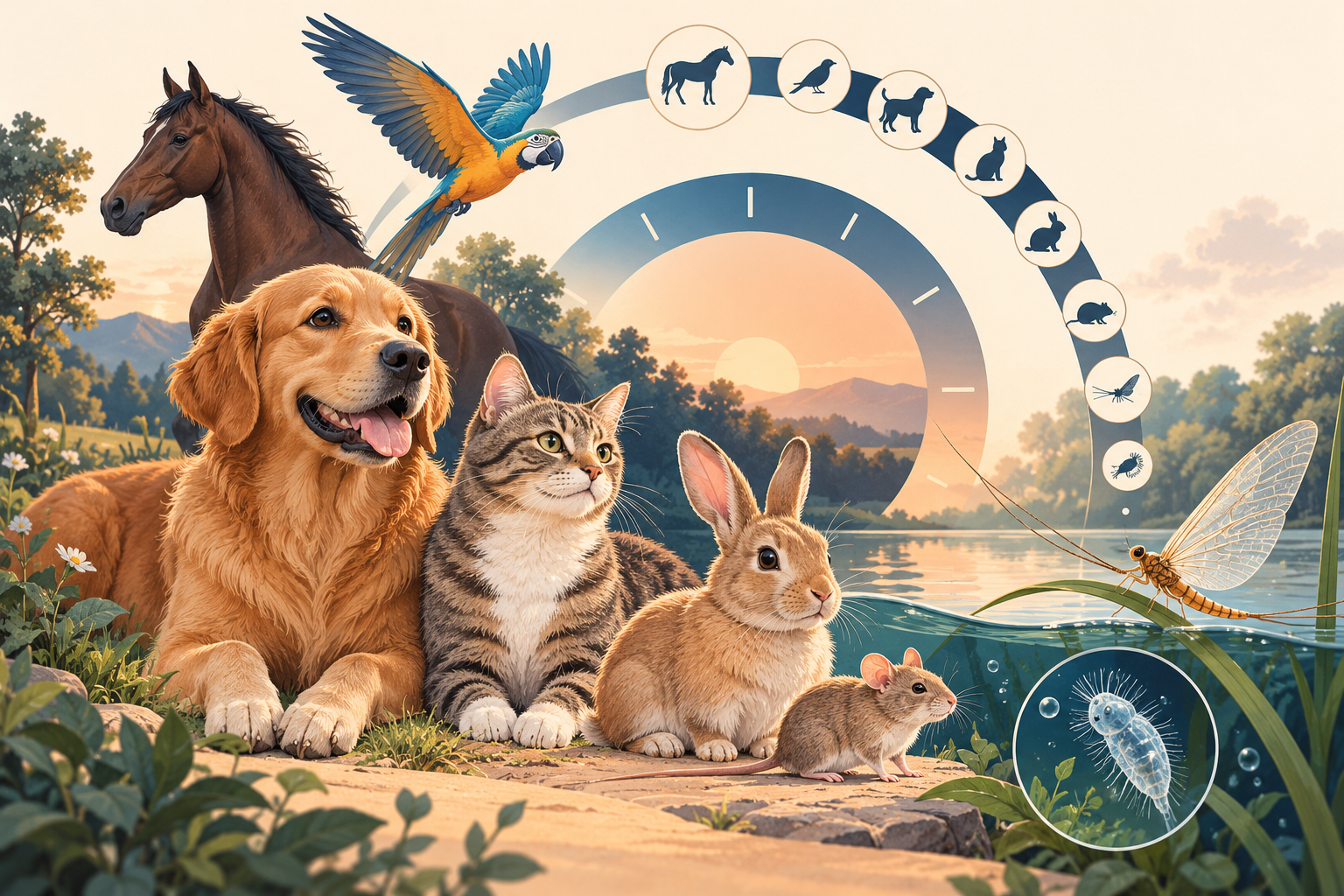
Life is usually measured in years, but weeks offer a simple way to compare how long different species live. Some animals share our lives for decades, while others complete parts of their life cycle in just a few days. Estimates vary by species, genetics, environment, and living conditions.
Dogs and cats: hundreds of weeks
Dogs and cats are familiar companions, but their life expectancy is not identical. A study using clinical records from millions of animals in the United States estimated life expectancy at birth at 12.69 years for dogs and 11.18 years for cats—about 660 and 581 weeks, respectively (Montoya et al., 2023). These are population averages, not predictions for an individual pet. Size also matters: in that study, smaller dogs tended to live longer than giant breeds. Veterinary care, healthy body weight, and living conditions all influence well-being throughout life.
Rabbits, guinea pigs, and hamsters
Small companion mammals have very different lifespans. Rabbits may live around 5–12 years (260–624 weeks); guinea pigs about 4–8 years (208–416 weeks); and hamsters around 1–3 years (52–156 weeks). These are approximate ranges: the specific species, diet, housing, and veterinary care can affect longevity. Body size alone cannot reliably predict how long an animal will live.
Mice: lives measured in dozens of weeks
Pet mice commonly live between 1 and 3 years, or about 52–156 weeks. They can reach reproductive maturity within a few weeks, so their generational cycle is much faster than that of larger animals. Estimates differ depending on whether the mice are pets, wild animals, or laboratory animals, since their living conditions vary. Although their lives are short, mice play important roles in ecosystems and biomedical research.
Animals that live only a few weeks
Gastrotrichs are among the animals with very short lifespans. These tiny, microscopic invertebrates live in aquatic environments and sediments. Animal Diversity Web reports lifespans of 3–21 days, from less than a week to around three weeks. They are part of microscopic communities that contribute to aquatic food webs (Animal Diversity Web, “Gastrotricha”). Identifying the single shortest-lived animal on Earth is difficult: many tiny species remain incompletely studied. It is more accurate to describe documented examples than to declare one absolute winner.
The documented adult reproductive phase of a female Dolania americana; this is not its full life cycle.
Mayflies: an adult stage lasting hours or days
Mayflies, insects in the order Ephemeroptera, are known for their brief adult stage. Some survive for only hours, while others live for a day or several days. However, saying that a mayfly lives for only hours can be misleading if the full life cycle is ignored. Before becoming an adult, it passes through an aquatic immature stage that may last months or even years, depending on the species. In *Dolania americana*, the female’s reproductive phase may last less than five minutes after the final molt. That figure refers to a brief adult reproductive phase, not the animal’s entire life (University of Florida, Book of Insect Records).
Horses and birds: lifespans of decades
At the other end of the spectrum, some animals can live for decades. Horses commonly reach around 25–30 years under favorable conditions, equivalent to about 1,300–1,560 weeks. Bird longevity varies widely: some small species live only a few years, while certain parrots may live for several decades with appropriate care. Species, environment, and husbandry are essential when interpreting any estimate.
A different perspective on lifespan
Comparing animals in weeks makes the diversity of their life cycles easier to visualize. A dog may live for hundreds of weeks; a mouse for dozens or more than a hundred; a gastrotrich for only a few days; and an adult mayfly, in some cases, for only hours. These differences do not make one life more important than another. Each organism has a place in its ecosystem and is adapted to a particular way of surviving and reproducing. Longevity is only one dimension of biological existence.
Life is measured not only by how long it lasts, but also by the role it plays in its environment.
References
- Montoya M, Morrison JA, Arrignon F, et al. Life expectancy tables for dogs and cats derived from clinical data. Frontiers in Veterinary Science. 2023. https://doi.org/10.3389/fvets.2023.1082102
- Wright J. Gastrotricha. Animal Diversity Web. https://animaldiversity.org/accounts/Gastrotricha/
- University of Florida. Book of Insect Records: Shortest Reproductive Life. https://entnemdept.ufl.edu/walker/ufbir/chapters/chapter_37.shtml
Explore your life in weeks
The longevity of different species offers another way to think about time and what it means to be alive.
Return to the toolA biological comparison, not an individual prediction.